When a Vulnerability Becomes Actively Exploited, the Risk Conversation Changes
Why active exploitation turns patching from an IT maintenance task into an operational risk decision.
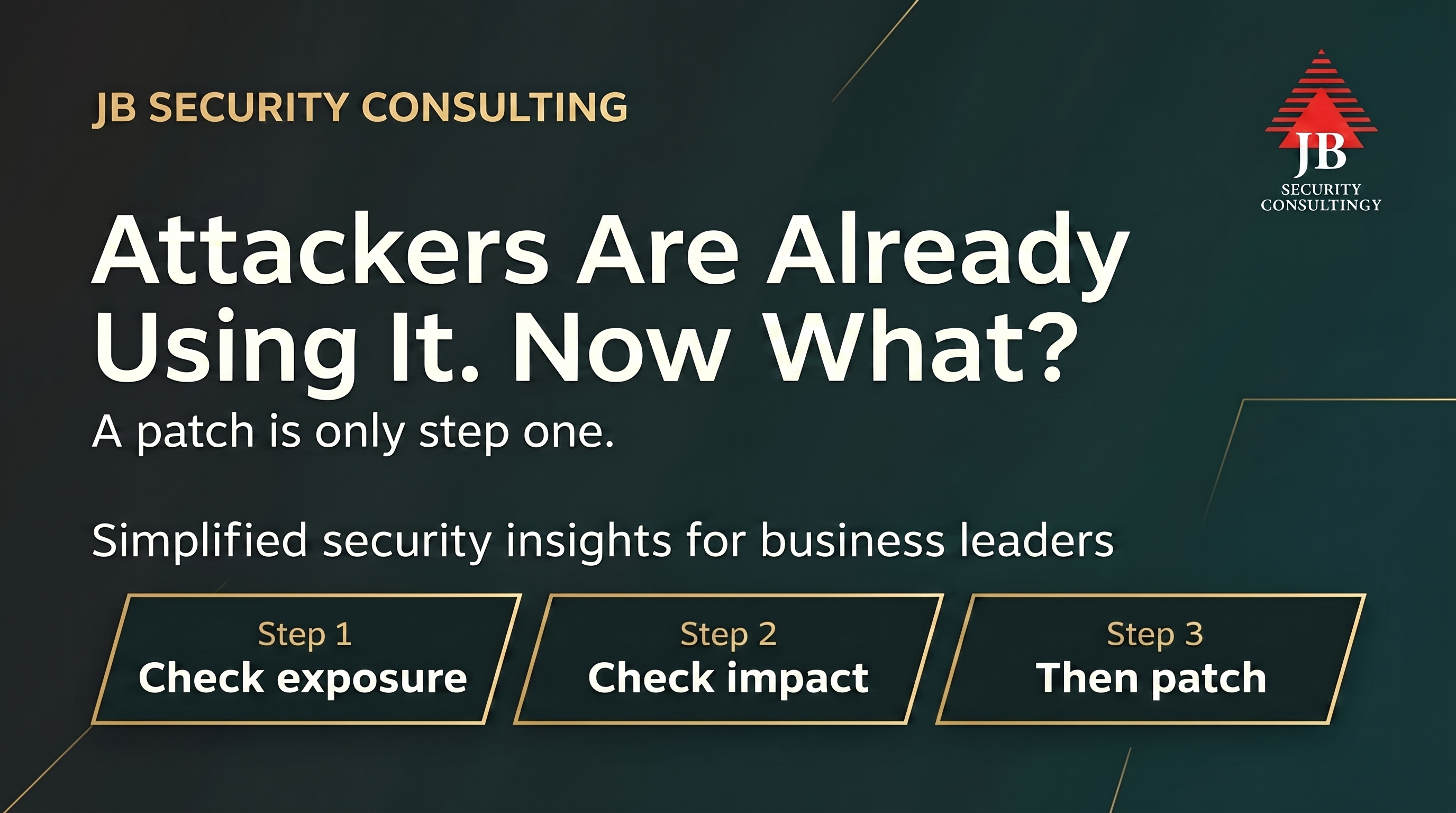
CISA recently added a Progress LoadMaster command injection vulnerability, CVE-2026-8037, to its Known Exploited Vulnerabilities Catalog after evidence of active exploitation.
For many organisations, this is the point where a vulnerability stops being a technical backlog item and becomes an operational risk decision.
The issue is not only that a product has a flaw. The issue is that attackers are already trying to use it, and the affected technology may sit close to important services. Load balancers, remote access tools, VPNs, identity systems, monitoring platforms, and other edge-facing systems often create more risk than their name suggests because they can become a route into the wider environment.
That is why vulnerability management should not be treated as a simple list of patches.
Security leaders need a way to answer four practical questions:
- Is the affected system exposed to the internet or reachable by untrusted users?
- Is the vulnerability known to be actively exploited?
- Would compromise give an attacker privileged access, command execution, or a route deeper into the business?
- Has the organisation checked for signs of compromise before assuming that patching alone is enough?
CISA's KEV Catalog is useful because it helps organisations move from theoretical severity to real-world prioritisation. A vulnerability with active exploitation deserves different attention from one that is only sitting in a future maintenance queue.
The practical lesson for business leaders is simple: security patching needs context.
A risk-based approach should consider exposure, exploit activity, business impact, compensating controls, and evidence of compromise. If an appliance is public-facing and compromise could lead to command execution or internal access, the response should be urgent, documented, and verified.
For organisations that do not have large internal security teams, this is where process matters. Someone still needs to maintain an asset list, monitor credible advisories, understand which systems are exposed, apply updates quickly, and confirm whether suspicious activity occurred before the fix.
The goal is not to panic every time a new CVE appears. The goal is to know which vulnerabilities actually change the risk picture.
That is the difference between patching as an IT task and vulnerability management as a security discipline.
JB Security Consulting supports organisations that need practical security, risk, and operational readiness guidance. If your organisation is reviewing exposed systems, critical assets, or security response processes, the first step is understanding where your real risk sits.